
The short answer
Replace a furnace when it's unsafe, keeps breaking down, or can't heat your home evenly. Otherwise, a targeted repair may be all you need. Bay Area rules don't force you to replace working equipment, but gas furnaces made from 2029 must be zero-NOx, so many San Jose homeowners consider a heat pump when replacement time comes.
In San Jose, a furnace doesn't run hard for months the way it does in colder parts of the country. The Santa Clara Valley's mild, damp winters mean many systems run in short bursts on chilly mornings and evenings, then sit idle for long stretches. That makes problems easy to miss until the first cold week of the season. This page explains how to tell when a furnace needs replacing, what we look at before recommending anything, and how to weigh repair against replacement under current Bay Area rules. It also covers what drives the cost of a new system and what to expect when we come out.
Signs You May Need a New Furnace
Age alone isn't a reason to replace a furnace. What matters is how it's performing and whether it's still safe to run. These are the signs that usually lead homeowners to call us:
If you ever suspect carbon monoxide, get everyone out of the house. Call 911 or your gas utility from outside, and don't go back in until it's cleared. That comes before any service call.
- The same part keeps failing, or repairs have become a regular part of every heating season.
- Some rooms stay cold while others overheat, even with vents open and a clean filter.
- The furnace short-cycles, turning on and off without ever warming the house.
- You hear banging, scraping, or loud rumbling when the burners light or the blower starts.
- Your gas bills creep up even though your habits haven't changed.
- The burner flame looks yellow or flickering instead of steady blue, or you see soot or rust around the unit.
- Your carbon monoxide alarm has gone off, or people in the house get headaches that ease when they leave.
What We Check Before Recommending Anything
Before we suggest a new furnace, we figure out whether the current one actually needs to go. A replacement recommendation should be based on what we find, not on the date printed on the label. During an inspection, we look at:
Sizing matters more than most people expect. Many older South Bay homes have had additions, new windows, or insulation upgrades since the original furnace went in. An oversized unit in a mild climate tends to short-cycle, wear out faster, and leave the house uneven. If you replace, we size the new system for the house as it is now, not as it was decades ago.
- Heat exchanger condition, including cracks, corrosion, or signs of overheating
- Burners, ignition system, and flame sensor
- Venting and flue connections, draft, and clearances
- Gas supply connections and shutoff valve
- Blower motor, blower wheel, and electrical components
- Air filter, return air path, and overall airflow
- Accessible ductwork, including obvious leaks or disconnected runs
- Thermostat operation and wiring
- Furnace capacity compared to the home it's heating
Repair or Replace: Your Options Under Bay Area Rules
If the problem is a single worn part, such as an igniter, flame sensor, blower motor, or control board, repair is often the sensible choice. That's especially true when the heat exchanger and venting are sound. We'll tell you when that's the case.
Replacement starts to make sense when the heat exchanger is compromised, when repair bills keep stacking up, or when the system can't keep the home comfortable no matter how it's adjusted.
Bay Area Air District rules also factor into the decision. Under Rule 9-4, natural gas furnaces manufactured from 2029 onward must meet a zero-NOx emission standard. In practice, that points homeowners toward heat pumps when a furnace is replaced after that date. The rules do not require you to replace working equipment. They only apply when a furnace fails or is replaced, so there's no need to pull out a furnace that's still doing its job.
When you do replace, the main options are a new gas furnace, a heat pump, or a dual-fuel setup that pairs the two. Because the valley's winters are mild, heat pumps tend to work well here. Many homeowners use a replacement as a chance to add efficient cooling, which helps in the hotter inland and southern parts of the valley. We'll walk through the trade-offs for your house instead of pushing one answer.
- Gas furnace: a familiar option, often paired with an existing or new air conditioner
- Heat pump: one electric system that handles both heating and cooling
- Dual fuel: a heat pump handles most of the heating, with a gas furnace as backup on the coldest days
What Affects the Cost of a New Furnace
We don't quote a number until we've seen the home, because the price depends on details like these:
On incentives: the federal Energy Efficient Home Improvement Credit (25C) covered qualifying heat pumps placed in service before December 31, 2025, so it isn't available for new installations now. Bay Area homeowners can check BayREN and their local clean energy provider for current heat pump and electrification incentives. Amounts and availability change by funding cycle, so we confirm the current offer before including it in any quote.
- System type: gas furnace, heat pump, or dual fuel
- Equipment efficiency and features, such as single-stage versus variable-speed blowers
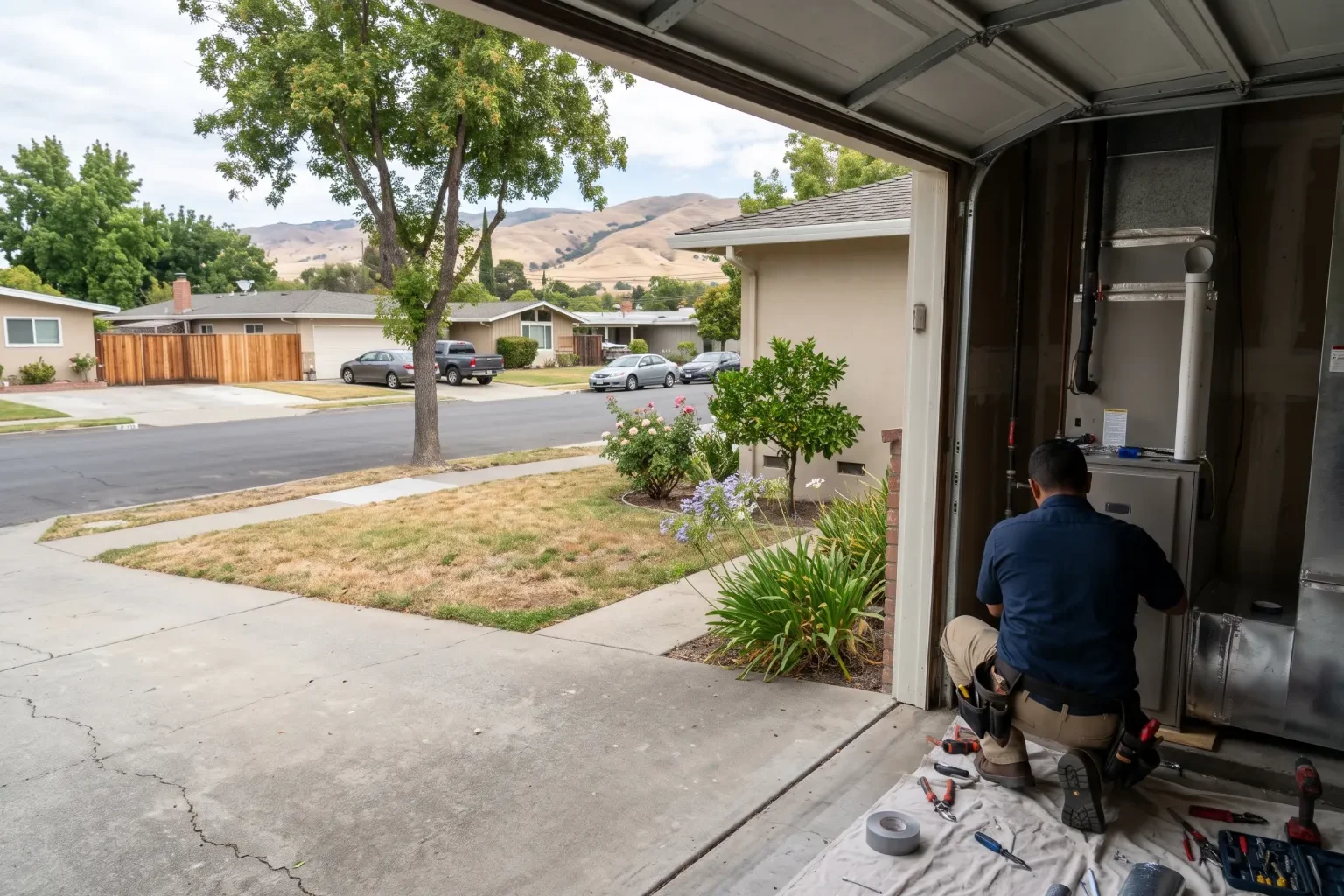
- Where the unit sits (attic, garage, closet, or crawlspace) and how easy it is to reach
- Changes to venting, gas lines, or electrical service, which are common when switching to a heat pump
- Ductwork condition and any repairs or modifications needed
- Thermostat upgrades
- Permit requirements in your city
How a Furnace Installation Visit Works
Here's what to expect from first call to finished job:
A like-for-like furnace swap is often finished in a day. Switching to a heat pump, or work that involves electrical or duct changes, can take longer. We'll tell you the expected timeline before work starts.
- We schedule a time that works for you and ask what you've noticed about your heating.
- A technician inspects the furnace, venting, airflow, and ductwork, then explains the findings in plain terms.
- If a repair makes sense, we say so. If replacement is the better route, we go over your options and give you a written quote.
- Once you decide, we handle the permit and schedule the installation.
- On installation day, we protect floors and work areas, remove the old equipment, install and connect the new system, and test it for safe operation.
- Before we leave, we show you how to use the thermostat, change the filter, and keep up with routine maintenance.